You do not need to recognize every dish on a French menu to understand your choices. Start with the sections, then look for words you already know: ingredients, ways of preparing food, side dishes, and familiar regional dishes.
For ordering phrases and talking with the server, see Menus and ordering.
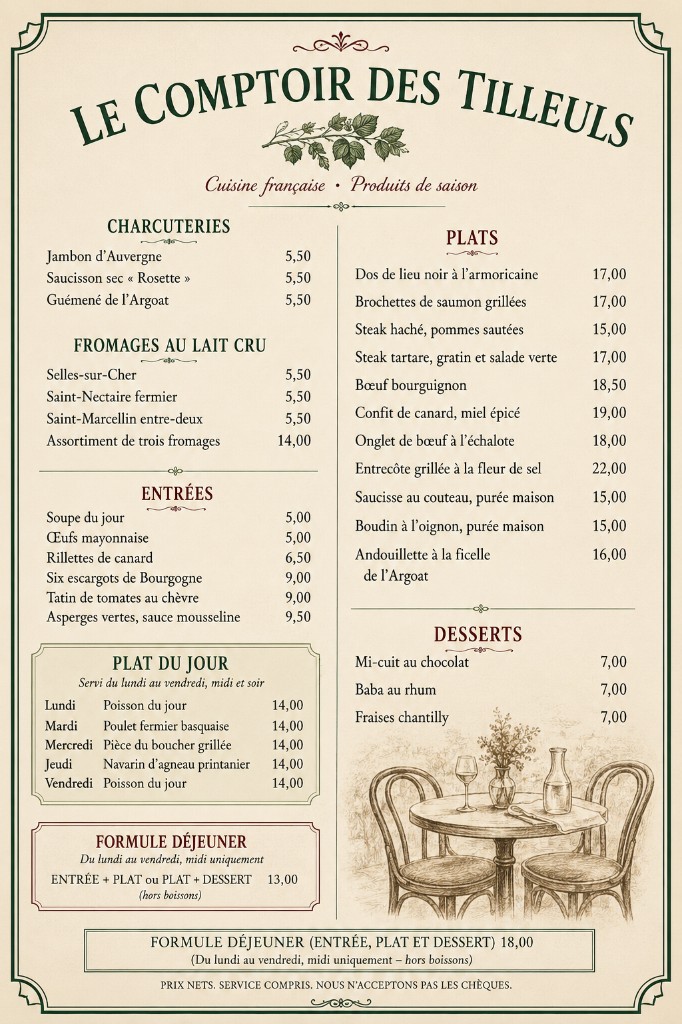
Start with the sections
Before reading individual dishes, find the main divisions of the menu:
| French | English |
|---|---|
| les charcuteries | cured meats / charcuterie |
| les fromages au lait cru | raw-milk cheeses |
| les entrées | starters / appetizers |
| les plats | main dishes |
| les desserts | desserts |
| le plat du jour | daily special |
| la formule déjeuner | lunchtime set menu |
The headings tell you what kind of choices you are looking at before you read any of the individual dishes. If you are looking for a starter, for example, you can go directly to les entrées. If you want cheese or charcuterie, those have their own sections on this menu.
Read the menu for words you recognize
You do not need to understand every word in a dish. Start with the words you recognize and use them to work out what the item might be:
| On the menu | What you can recognize |
|---|---|
| Saucisson sec « Rosette » | saucisson = sausage, sec = dry |
| Rillettes de canard | canard = duck |
| Six escargots de Bourgogne | escargots = snails, Bourgogne = Burgundy |
| Onglet de bœuf à l'échalote | bœuf = beef, échalote = shallot |
| Saucisse au couteau, purée maison | saucisse = sausage, purée = mashed potatoes, maison = house-made |
| Fraises chantilly | fraises = strawberries, chantilly = whipped cream |
Recognizing only part of a description can still tell you quite a lot. Rillettes de canard, for example, tells you that the dish contains duck even if you do not yet know what rillettes are.
Look for how the food is prepared
Once you recognize the main ingredient, look at the words around it. On this menu, a comma often separates the main dish from what is served with it:
| French | English |
|---|---|
| entrecôte grillée à la fleur de sel | grilled rib steak with sea salt |
| Saint-Nectaire fermier | semi-soft cow's-milk cheese from Auvergne |
| onglet de bœuf à l'échalote | hanger steak with shallot |
| saucisse au couteau, purée maison | coarse-cut sausage with house-made mashed potatoes |
| confit de canard, miel épicé | duck confit with spiced honey |
For example, in entrecôte grillée à la fleur de sel, grillée tells you how the steak is prepared, while à la fleur de sel tells you how it is seasoned. You can learn quite a bit about a dish without understanding every word in its name.
Look for what comes with it
On the menu, a comma often separates the main dish from what is served with it:
Steak tartare, gratin et salade verte
You may not know exactly how steak tartare is prepared, but gratin et salade verte tells you that it comes with gratin and a green salad.
The same strategy works with saucisse au couteau, purée maison: a coarse-cut sausage served with house-made mashed potatoes. Even if part of a dish is unfamiliar, the rest of the description can tell you a lot about what you will get.
Some names have to be learned
Not every dish can be understood by breaking its name into familiar words.
Bœuf bourguignon, andouillette, rillettes de canard, and baba au rhum are names you may need to recognize or find out more about. Even when part of the name is familiar, it may not tell you what the dish actually is.
You can ask:
| French | English |
|---|---|
| Qu'est-ce que c'est ? | What is it? |
| Qu'est-ce qu'il y a dedans ? | What's in it? |
| Ça vient avec quoi ? | What does it come with? |
Here is what the examples from the menu refer to:
| French | What it is |
|---|---|
| bœuf bourguignon | beef slowly cooked in red wine with vegetables |
| andouillette | strongly flavored sausage made from pork intestines |
| rillettes de canard | shredded duck cooked slowly in fat and served as a spread |
| baba au rhum | small yeast cake soaked in rum syrup |
Finding the daily special
The menu from Le Comptoir des Tilleuls shown above has a plat du jour section, with a different daily special from Monday through Friday.
| Day | Plat du jour | English |
|---|---|---|
| lundi | poisson du jour | fish of the day |
| mardi | poulet fermier basquaise | Basque-style free-range chicken |
| mercredi | pièce du boucher grillée | grilled butcher's cut |
| jeudi | navarin d'agneau printanier | spring lamb stew |
| vendredi | poisson du jour | fish of the day |
In a restaurant or bistrot, the plat du jour may not appear on the printed menu at all. It is often written on l'ardoise, a chalkboard displaying the day's dishes and other specials. You might hear C'est sur l'ardoise or Regardez l'ardoise when asking what is available that day.
If someone tells you Aujourd'hui, le plat du jour, c'est le poulet fermier basquaise, you now know where that choice fits into the menu.
Understanding the formule
At the bottom of the menu is a formule déjeuner. Instead of choosing and paying for each course separately, you choose a combination for a set price.
The menu gives you three options:
| French | What you get |
|---|---|
| entrée + plat | a starter and a main course |
| plat + dessert | a main course and a dessert |
| entrée + plat + dessert | a starter, a main course, and a dessert |
With the first two formules, you choose either an entrée or a dessert along with a plat. The third formule includes all three courses: entrée + plat + dessert.
Pay attention to restrictions such as du lundi au vendredi, le midi uniquement, and hors boissons. They tell you when the offer is available and what the price includes.
From learning to practice
Take a menu you have never seen before and read it in passes. Find the sections first, then identify dishes containing words you recognize, and only look up the remaining words when you need them to understand something you might actually order.