In everyday French, when you talk about an event that finished in the past, you often use the passé composé: a helper verb plus a past participle. The two shapes are:
avoir + past participle
être + past participle
Most verbs use avoir as the helper:
| French | English |
|---|---|
| J'ai mangé. | I ate. / I have eaten. |
| Tu as parlé. | You spoke. / You have spoken. |
| Nous avons pris le bus. | We took the bus. |
A smaller group takes être:
| French | English |
|---|---|
| Je suis allé. | I went. / I have gone. |
| Elle est arrivée. | She arrived. |
An important skill to develop at A1 is hearing which helper belongs with each verb. Start with avoir as the default. Then learn the être set well enough that j'ai arrivé and j'ai allé start to sound wrong.
For the verbs themselves, see How to use avoir and How to use être. For the full tables, see the conjugations of avoir and être.
Start with avoir
Build the past with a present form of avoir plus a past participle:
avoir + past participle
Here are some common examples:
| French | English |
|---|---|
| J'ai fini mes devoirs. | I finished my homework. |
| Elle a fait un gâteau. | She made a cake. |
| Nous avons regardé un film. | We watched a film. |
| Ils ont bu un café. | They had a coffee. |
That is the pattern you will use most often. If you are unsure, avoir is the safer first guess for many common verbs (manger, parler, finir, prendre, faire, avoir, être as j'ai été).
Then learn the être house set
Build the past with a present form of être plus a past participle:
être + past participle
A lot of the être verbs describe movement around a place: toward it, away from it, in, out, up, or down. A house makes that set easier to hold in mind.
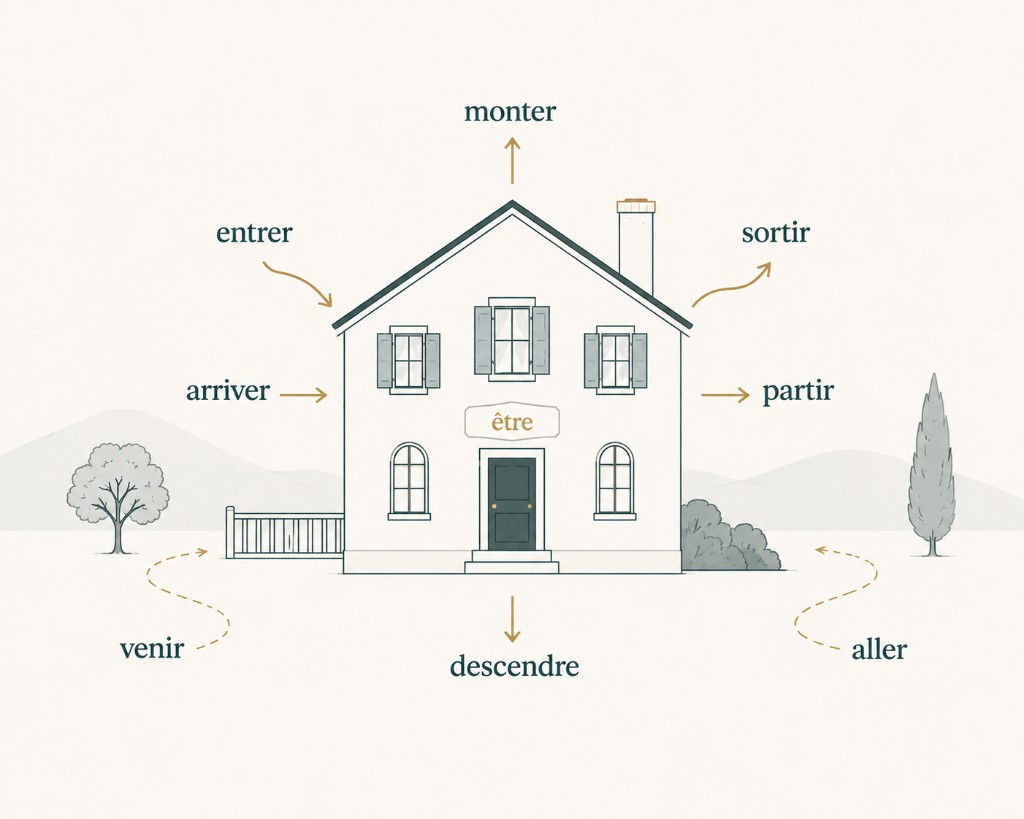
The picture is a memory aid for eight high-frequency verbs: aller, venir, arriver, partir, entrer, sortir, monter, descendre. Many describe movement from one place to another.
| French | English |
|---|---|
| Je suis venu à pied. | I came on foot. |
| Elle est sortie tôt. | She went out early. |
| Nous sommes montés au premier étage. | We went up to the first floor. |
| Ils sont descendus dans la rue. | They went down into the street. |
A few more être verbs to add next
After the house verbs, the next useful additions are rester, tomber, naître, and mourir.
| French | English |
|---|---|
| Je suis resté à la maison. | I stayed at home. |
| Elle est tombée. | She fell. |
| Je suis né en 2001. | I was born in 2001. |
| Mon grand-père est mort en 2010. | My grandfather died in 2010. |
You do not need a complete inventory on day one. Get the house verbs solid, then grow the list.
Hear the agreement with être
With être, the past participle usually matches the subject. Train your eye and ear on the ending, not on a full agreement list.
| French | English |
|---|---|
| Il est arrivé. | He arrived. |
| Elle est arrivée. | She arrived. |
| Elles sont arrivées. | They arrived. |
With avoir, you can ignore agreement for now in basic A1 lines. Focus first on choosing the right helper.
Later you'll discover that a few movement verbs can use avoir when they take a direct object.
Common mistakes
These mistakes usually come from English "I have…" landing on avoir by habit, or from missing agreement after être.
| Incorrect | Correct |
|---|---|
| J'ai arrivé hier. | Je suis arrivé hier. |
| Elle a allé au cinéma. | Elle est allée au cinéma. |
| Nous avons partis à midi. | Nous sommes partis à midi. |
| Elle est arrivé. | Elle est arrivée. |
Say the correct column out loud. Then read the incorrect one again. The goal is for the wrong helper to feel strange.
Before you go
Treat avoir as the default past helper. Use the house map for the common être motion set, then add the extra verbs when you are ready. Watch agreement after être.